

Oil prices could reach $100 per barrel if there were "dramatic" developments in the Gulf or elsewhere, a leading oil official has said.

The country's exports edged up 1 per cent to $38.45 billion in December 2023 while the trade deficit narrowed to a three-month low of $19.8 billion, official data released on Monday showed. Imports declined by 4.85 per cent to $58.25 billion in December last year due to a dip in crude oil shipments. The previous low in trade deficit - the difference between imports and exports - was recorded in September at $19.37 billion.
The UAE will comply with the Organisation of Petroleum Exporting Countries' directive to reduce its output by 1 million barrels a day, from the official quota of 28 million barrels, Minister of Energy Mohammed bin Dhaen Al Hameli said.
OPEC members are meeting at Vienna on Monday. Jason Feer of Argus Media thinks that the fear as to how far the oil prices could drop would be uppermost on the minds of the ministers meeting in Vienna.

Here is a list of Q & As to explain these issues and implications of the US move.

'While the President has been critical of India, he has gone out of his way to compliment PM Modi. They have an incredible relationship.'

India's demand for petroleum products like petrol and diesel will grow by 7.73 per cent in 2022, the fastest pace in the world, an OPEC report said. India's demand for oil products is projected to rise from 4.77 million barrels per day (bpd) in 2021 to 5.14 million bpd in 2022, OPEC said in its monthly oil report. The growth in demand is the fastest in the world ahead of 1.23 per cent of China, 3.39 per cent of the US and 4.62 per cent of Europe.
The country's exports rose by 23.69 per cent to $34.06 billion in January on healthy performance by engineering, petroleum and gems and jewellery segments even as trade deficit widened to $17.94 billion during the month, according to provisional data of the commerce ministry. Imports in January grew by 23.74 per cent to $52.01 billion, the data, released on Tuesday, showed. Trade deficit widened to $17.94 billion during the month as against $14.49 billion in the same month last year.

The Organization of the Petroleum Exporting Countries (Opec) and its partners, such as Russia, collectively termed Opec+, have decided to cut crude oil production by 100,000 barrels per day (bpd) from October onwards, at a meeting on Monday. In a step that may increase prices in India, the group has decided to reduce output quotas for October, after a fall in global oil demand outlook. The cut in output is equal to 0.1 per cent of global supply.
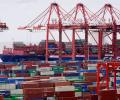
The country's exports for the first time crossed the $400 billion mark in a fiscal on healthy performance by sectors such as petroleum products, engineering, gems and jewellery, and chemicals, according to the commerce ministry's data released on Wednesday. The merchandise exports rose by by 37 per cent to $400.8 billion in 2021-22 until March 21 against $292 billion in 2020-21. Previously, the outbound shipments had touched a record of $330.07 billion in 2018-19.
Exports contracted by 2.6 per cent to $34.47 billion in September even as the country's merchandise trade deficit narrows to $19.37 billion during the month under review, according to the government data released on Friday. Easing commodity prices helped in cutting down the country's import bill by 15 per cent to $53.84 billion in September, the 10th consecutive month of decline. During April-September this fiscal, exports contracted by 8.77 per cent to $211.4 billion.

Of Trump's reciprocal tariffs and trade deals

India imports about 25 million tonnes of oil from Iraq each year.

Imports rise at highest pace in more than 2 years as crude oil price spikes.

The ministry of finance is likely to assume crude oil price to remain within $85 per barrel while estimating subsidies for the Interim Budget 2024-25 (FY25), to be presented on February 1. Brent crude prices moved up on Thursday, ending at $78.9 per barrel. Crude oil and cooking gas prices, which move in tandem, impact fertiliser and cooking gas subsidies, constituting 53 per cent of the government's total subsidies.
The country's exports surged 49.85 per cent to $35.43 billion in July on account of healthy growth in petroleum, engineering, and gems and jewellery segments, even as the trade deficit widened to $10.97 billion during the month, official data showed on Friday. Imports during the month also rose by about 63 per cent to $46.40 billion, as per the data released by the commerce ministry.

The country's exports grew by 47.19 per cent to $35.17 billion on account of healthy growth in the outbound shipments of petroleum, engineering, and gems and jewellery, according to the provisional data of the commerce ministry. Imports during the month also rose by 59.38 per cent to $46.40 billion, leaving a trade deficit of $11.23 billion. Exports of petroleum, engineering, and gems and jewellery in July increased to $3.82 billion, $2.82 billion and $1.95 billion respectively, the data showed.

The escalation of conflict in the West Asian region is expected to push already high logistics costs besides hurting trade in sectors such as oil, electronics and agriculture, according to exporters. They said that insurance costs for exports to the countries directly involved in the war could also go up, which will impact Indian exporters' working capital. Think tank Global Trade Research Initiative (GTRI) stated that the conflict is already hurting India's trade with countries like Israel, Jordan, and Lebanon.
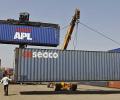
India's exports dipped deeper in the negative zone.

The importance of China as India's top trading partner cannot be understated.

The surprise decision of OPEC and its allies, including Russia, to cut oil output may cause an immediate rise in prices, delaying revision in fuel prices in India, industry sources said. The grouping of Organisation of Petroleum Exporting Countries (OPEC) and its allies, called OPEC+, on Sunday decided to further cut oil output by around 1.16 million barrels. The move led to Brent rising by almost 6 per cent to $84.58 per barrel on Monday.
Uncertainty looms over India's export outlook, with the new Covid-19 variant Omicron spreading rapidly across the country's key shipment destinations. With the US and parts of Europe witnessing more than 100,000 Covid-19 cases a day, exporters expect some disruption. However, there may not be an immediate decline in exports from India because the order books remain strong at least for the next few weeks, they said.

After recording positive growth for two months in a row, India's exports dipped marginally by 0.25 per cent to $27.67 billion in February and trade deficit widened to $12.88 billion, according to preliminary data released by the government on Tuesday. Imports grew 6.98 per cent to $40.55 billion during the month, the data showed. The trade deficit stood at $10.16 billion in February 2020. Exports during April-February 2020-21 were $255.92 billion, compared with $291.87 billion during the same period of last year, exhibiting a negative growth of 12.32 per cent.

'Many countries believe that if they join BRICS, they will be seen as emerging countries and their stature will be enhanced.' 'G-20 still has common action plans while BRICS does not do that much.'

India's exports fell for the fourth straight month in June as shipments of key segments like petroleum and textiles declined but the country's trade turned surplus for the first time in 18 years as imports dropped by a steeper 47.59 per cent.
India's exports contracted by 22 per cent, the steepest decline in the last three years, to $32.97 billion in June on account of global demand slowdown, especially in the Western markets like the US and Europe. According to the data of the commerce ministry, the trade deficit in June stood at $20.3 billion against $22.07 billion in the same month last year due to a fall in exports and imports. The inbound shipments during the month under review declined by a steep 17.48 per cent to $53.10 billion.
The oil industry experienced three upheavals between 1973 and 1991, which seem to be etched in the memory of the industry's decision makers. Naturally, at the sign of a new crisis, the decision makers like to dip into those tumultuous decades to find ways to deal with the new shock, in addition, of course, to expert reports and forecasts. So, the industry bigwigs turned the pages of history to get a peek into the future of oil price movements after Russia invaded Ukraine in 2022, Israel attacked Gaza in 2023, Iran-linked Houthi rebels pounded tankers crossing the Red Sea in support of Palestine the same year, and Iran rained missiles on Israel in 2024.

After contracting for six months in a row, the country's exports grew by 5.27 per cent to $27.4 billion in September, Commerce and Industry Minister Piyush Goyal said on Thursday.

India's import of cheap Russian oil scaled another record in May and is now more than the combined oil bought from Saudi Arabia, Iraq, UAE and the US, industry data showed. India took 1.96 million barrels a day from Russia in May, 15 per cent more than the previous high in April, according to data from energy cargo tracker Vortexa. Russia now makes up for nearly 42 per cent of all crude oil India imported in May.
The country's exports in December surged 37 per cent on an annual basis to $37.29 billion, the highest-ever monthly figure, government data showed on Monday.
Exporters on Thursday demanded fiscal incentives, tweaking in customs duties on certain products and credit at affordable rates in the forthcoming Budget to boost exports and create jobs. In a pre-budget virtual meeting with Finance Minister Nirmala Sitharaman, the Federation of Indian Export Organisations (FIEO) said the depreciation of the rupee against the US dollar is affecting exports' competitiveness and the sector requires more support. "Creation of employment is the biggest challenge faced by the country...We would urge the government to provide fiscal support to units which provide additional employment in the export sector," the exporter's body said.
Investors are showing some interest in the downstream energy cycle. Refiners and marketers, especially the public sector (PSU) oil marketing companies (OMCs) could see a revival of marketing margins. Lower crude oil and gas prices may also improve margins in industries like paints, logistics, synthetic fabrics, plastics, and fertilisers. In the medium-term, however, there could be a supply overhang affecting OMCs as new refining capacities are scheduled to be commissioned, especially in China, and this may lead to a drop in the refining margins as capacity would be surplus to demand until and unless there's a pick-up in global growth.

Trade deficit during the month narrowed to USD 14.54 billion from USD 15.3 billion in January 2020. It was USD 15.44 billion in December 2020.
Imports also fell for the eighth consecutive months, down 0.75 per cent to $41.14 billion in January, widening the trade deficit to a seven-month high of $15.17 billion.
